Sunday, 26 May 2013

Botanic Garden at Pocos de Caldos

One of the places the team visited was the botanic garden just outside Pocos de Caldos.

We had a presentation by the technical manager of the site who explained the reasons for the setting up of the organisation, and gave information about the different habitat areas of Brazil and the specific habitat types around Minas Gerais - which is one of the transition areas between Mata Atlantica, a forested region, and Cerrado - an area which is more savannah in nature.

We were shown maps that indicate the Mata Atlantica area is now substantially smaller than it would have been originally having been deforested over a few hundred years for farming (both animals and crops), land for building the cities and towns and also for mineral extractions, where they often use open cast mining systems that we previously had seen at the graphite and limestone quarries.

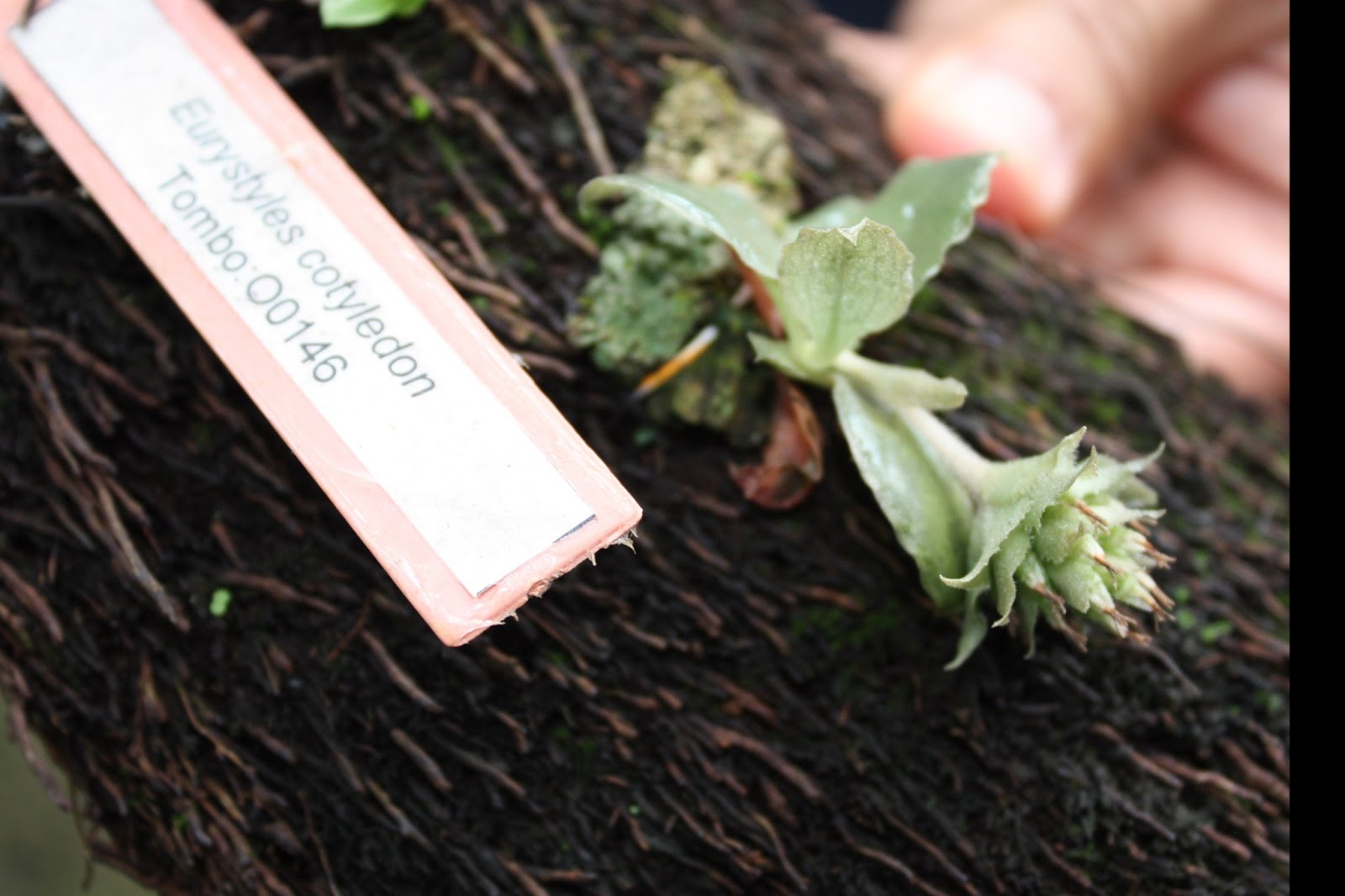
The botanic gardens had a compact area where they were growing a variety of native plants - mainly trees and orchids - that they were growing to reforest in certain areas and also in the case of one orchid which was now thought to be extinct in the wild.  They were attempting to get this orchid to propagate but have not yet been successful.  They were going to attempt micro-propagation however they have not yet got the necessary facilities to do this.


as can be seen by these photos, these orchids aren't necessarily big significant flowers and some are as inconspicuous as those that may be found in the UK - in that unless you know what you are looking at they will not be seen.
 
 
They propagate the native trees by seed taken from local areas that they wish to re-forest to ensure that the seed bank remains as local as possible.  The new trees being reared in greenhouses to start with and then taken outside to acclimatise.  In the UK obviously this would be called hardening off the plants to get them used to the cold weather - however in Brazil I think this is more a case of preparing them for the summer heat and the periods of drought that do occur in this area outside of the rainy season.


This is where it got a little surreal as they asked me to plant a tree in the grounds, ceremonial style with a spade of sorts and lots of photos were taken!  They are intending to place a plaque there as well!!  I don't think of myself as a VIP, but it was such an honour to be given the opportunity - but didn't feel suitably attired for the occasion - had I known I certainly would have covered my legs a bit better - but what the heck! 


It was good to go to the land of botanical names for a little while, although most I did not recognise!

The establishment itself had been started originally by monies given by what I believe was both the central government, state and also the city of Pocos de Caldos.  The buildings were built several years ago.   Though there were some language difficulties I managed to find out that it is now funded mainly be the industries that have been recently been those causing the deforestation - namely the mineral companies.  It is hoped that the works that take place here is sufficient to assist in the recovery of the areas where the loss of plants has occurred.

Saturday, 25 May 2013

Waterfalls, Lago de Furnas and hydro-electricity!

A broad topic to blog about but hopefully it will make sense!

Whilst here in Brazil we have been shown several waterfalls, which although are not in full flow - it being the dry season here, are still very dramatic and beautiful.

Some of these waterfalls have already been mentioned in the blog in other places, but here are a couple of photos to show you all what I mean...


These are part of a larger river and lagoon system found around Minas Gerais.  These lagoons are for the most part manmade by flooding the original river systems, but are nonetheless very beautiful and in places the local landowners have realised that placing housing areas for the more wealthy around these lagoons is a more profitable exercise than farming the land.  these are mainly in condominiums with main gates at the entrances allowing a more relaxed feel to the properties rather than the electric fences and high walls that surround the housing in more urban areas.  They are also a potential for tourism through water sports etc. 


Apologies for the tree - couldn't resist!  I think dead trees are quite sculptural (as long as they are not next to busy roads!)


This lagoon system or Lago de Furnas covers a huge area of Minas Gerais and has from what I can ascertain has two main functions.  To store water for use by the towns for general purpose things (but definitely unlikely to drink!) and also it is dammed so that it can be used to generate power.


I have read that nearly 90% of the electricity used in Brazil is produced via hydro-electricity.  We have been over and seen several dams and hydro-electric plants in our time here, some large like the photo above and some much small affairs where the water at the edge of a natural waterfall has been diverted to an often insignificant building at the side that unless you knew what it was would not even be noticed.


Caxambu - The District Conference

The big event of our trip arrived. We were to do our presentation in Portufese to any of the 1000 delegates who wished to attend the seminar.

We were also asked to give a more informal talk on our study exchange experiences so far.

Our slot was within the Rotary International Seminars and it was lovely to present next to our fellow GSE team who visited Lincolnshire and Yorkshire in 2012.

Our presentation went well, we are all clearly more comfortable with presentation delivery, public speaking, large audiences and cameras. For our second part we spoke in English and it was translated to Portugese, although the messages in our heartfelt speaches were clearly understood by our audiences.

Now the big presentation is done we are on a countdown to our four flight journey home. We have two cities left to visit the first of which, Lavaras we leave for tommorow.

Friday, 24 May 2013

Vila Vicentina

Today, I visited an asylum called Vila Vicentina. This was founded in 1945 by a nun called Sister Maria Antonia. As you pass the security doors, there is a sign saying in desperate need of food. The asylum houses 85 service users, with 39 female residents and 46 male service users. All of the service users have some degree of mental and physical health problems. The youngest resident here is 32 years old and the oldest is 92.

To get a place here, the family need to apply as they are themselves no longer able to look after them anymore. If the potential service user has worked in the past, then their pension will pay for their care, if they haven't, or have no pension, then their payment for their care is reliant on private donations, and the asylum will make an appeal to private donators for their care. The board of directors will decide whether a person is eligible to be cared for here, after looking through doctors notes and the families request form.

The asylum is very shabby, and the rooms are in need of refurbishment, but due to lack of finances, this has not been possible. The residents have limited entertainment, with very sparse T.V facilities or other things to do. The majority of the patients sit staring into space with virtually no stimulation. There is a chapel here and the grave of the founder, and each week they have a ceremony for her. Two of the residents help out around the gardens, which helps not only the service users in terms of their stimulation, but also the staff. There is a place where one of the residents was making art pieces which he sold this to make money for himself.


They change the patients nappies two patients at a time, and if they can stand, then this is done with them holding onto a metal bar.

There is limited staffing here, with only one member of staff , a nurse on at the night shift. If there is an emergency, then she needs to ask for the assistance of one of the more able residents to help. I said that this was dangerous, but the response was that the funding simply wasn't there.

The asylum has a door which joins to the hospital, but there is no ramp, which means the nurse has to lift the wheel chair up quite a high step to get the resident up.

One of the most upsetting parts was that only five of the residents have visitors and are able to get out. The rest of the residents have no one outside of the asylum who visit them. There are times when places like this make you realise how difficult life can be for some people.


Thursday, 23 May 2013

Music lessons and projects

I went to a public school in Pocos de Caldas. The children attending the school are aged between 6 and 11. The school is completely funded by the government here. The director of the school didn't speak any English, but had kindly invited her son to interpret, which was very useful. I was able to watch a music lesson, which is taught weekly to each class by a teacher specifically trained to teach the music. They were learning different rhythms and performing them by clapping and playing large calves and shakers. The school had made the shakers themselves, using cups, stones/hard beans and the cup lid. The teacher played a song on the CD player for the children to clap and play along to. She explained that she had recently attended a course to teach this.

One of the class members had recently moved from The United States, so spoke English. He was keen to talk to me and find out what I was doing here in Brazil. He has lived here for 6 months and was already translating questions from the other children to me. It just shows how quickly children can learn another language.


We were then taken to another part of the school to see a music project for the children and the community also. They were doing 'Capoeira' which originates from Africa and is a tribal dance representing a fight. The teacher and another student were playing a wooden string instrument that created a tuned rhythm. The children stood in a circle, whilst 2 carried out the 'fight'. The rest of the group clapped along with the rhythm. All of the children seemed to really enjoy this and were very good!

Serra de Canastra

After a long and bumpy ride we visited Serra de Canastra a beautiful waterfall.

The atmosphere was amazing, the water danced down the rocks creating dazzling displays accompanied by a calming and forceful noise from the water hitting the rocks beneath it.

There was a treck to get to the waterfall and to get close a rock climb but it was more than worth it.

The photographs dont do it justice. We have more pictures but these are just a few for you now so you can get an idea of our experience.

Wednesday, 22 May 2013

Boa Esperançe Major Meeting

We visited the City Hall of our new host city Boa Esperançe. We were lucky enough to interview the new Mayor who has been in post 6 months of his 4 year term.

I asked the Mayor about housing strategies for the people of the city in need of housing and better quality homes.

My House My Life Programme

This programme is funded by Federal Government and managed by the Municipal Government (local council) to help people who own land build a house on it, or to help people who have a poor quality home knock it down and rebuild a house to a modern standard.

There is a possibility that funding from Federal Government may not cover all of the planned builds (see below). In these instances the City will look to provide the funding to complete the programme.

Implementation of Programme

The plan is for 58 homes to be built undrr this programme in the next 6 months.

The next phase of the project will see a further 150 new homes built.

The following 4 years will see 120 new homes a year built.

Eligibility

There is a National Federation Box which is an office within the city where famalies applying for the scheme apply. There are checks to ensure the family are on a low income, do not have the means to build a home without assistance and the home they currently own (if any) is of a poor standard requiring upgrade.

Homelness

There is around 1100 known people in the city that dont have their own home and are staying with friends or relatives or homeless.

These people are given an allowance to help towards their living costs providing they meet the eligibility criteria, which is a low income.

The City also has plans to build properties for these people using City funds in future projects.

Social Issues

The discussion then lead onto other aspects that can be common in famalies who have low incomes and are in need of suitable housing.

There is in this city (and others within the state of Mineas Gervais) a rising drug problem.

The problem is partly associated to from the close location to Latin America where crack cocaine production is high. There us also a high cannabis and cocaine production here in Brazil, the climate is suitable for mass production.

The state of Sao Paulo has recently been in the news due to large cocaine production busts.

The Police, including boarder forces work tirelesly to stop the cultivation, supply and dealing of drugs.

The social schemes for young people here (as featured in previous blog posts) are an effective way of helping break the cycle of hanging around on the streets,taking drugs, then dealing or engaging in prostitution to fund buying more drugs that is a common theme in the socially deprived areas.

Rehabilitation

The social schemes here offer many rehabilitation programmes (some mentioned in previous blog posts) which are voulantary but people can also be taken by force to more intense rehabilitation programmes.

At present the city provides $800 for each person who requires rehabilitation care. There is currently work with Rotary to build a new facility for rehabilitation here.

Free Study For Children

The Government have created funds for free university courses for adults who could not afford to pay pri
Gov also iffering free courses at fed uni.

Other Community Developments

In addition to this fantastic work the Mayor also hopes to build the following community facilities;

Childcare for children at risk

Soccer clubs in social risk areas

Residential Mental Healthcare

Tourism

As the city is built around one of the biggest lakes in the country. The lake named Lago De Furnas.

Work has begun in building a damn for hydro electicity. This is a common powersource in this state due to the amount of lakes and waterfalls.

The annual Jet Ski Championships are held here and there are plans to develop the lake for the use of watersports.

There are also great views fro. Local mountians and work is planned to improve the roads to these attractions. At the moment the routes are definatley off road but to me were part of an adventure to get to the stunning veiws of the city.